
What Happens to Your Old Laptop After You Sell It for Recycling?
You’ve finally decided to part ways with that old laptop sitting in your cupboard — the one with the cracked hinge, the sluggish fan, and three years of files you keep meaning to back up. You hand it over to a recycler, get your payment, and move on with your day.
But have you ever wondered what actually happens to it after that?
Most people assume their old laptop simply gets “melted down” somewhere. In reality, it goes through a detailed, multi-stage journey — one that involves data protection, careful testing, component recovery, and environmentally responsible processing. Here’s what really happens behind the scenes.
Step 1: Collection and Documentation
The moment your laptop is picked up, it’s logged into an inventory system. A responsible recycler records the make, model, serial number, and condition of the device before it goes anywhere near a processing unit. This isn’t just paperwork for its own sake — it’s what allows the recycler to issue you a proper acknowledgement, and later, a certificate confirming the device was collected and processed.
For businesses disposing of multiple devices at once, this documentation becomes especially important for audits, asset registers, and internal compliance records.
Step 2: Secure Data Destruction
This is the step most people worry about the most — and rightly so. Your laptop’s hard drive or SSD doesn’t just hold files; it holds passwords, saved logins, financial records, photos, and sometimes years of work history.
Before a laptop is refurbished or dismantled, its storage drive goes through secure data destruction. Depending on the device and its intended next step, this can mean:
- Data wiping — overwriting the drive multiple times using certified software so the original data becomes unrecoverable, useful when the drive itself will be reused.
- Degaussing — using a strong magnetic field to scramble data on the drive.
- Physical destruction — shredding or crushing the drive so it can never be read again, typically done when the drive is beyond reuse.
A trustworthy recycler will be able to give you a data destruction confirmation as part of the process, so you have proof your information was handled securely.
Step 3: Assessment — Refurbish or Recycle?
Once the data risk is eliminated, the laptop is assessed for its second life. Not every old laptop is scrap. Recyclers evaluate:
- Age and configuration (processor, RAM, storage)
- Physical condition — screen, keyboard, battery, ports
- Whether faulty parts can be repaired or replaced
- Market demand for that model or its components
Laptops that pass this check are cleaned, repaired if needed, and prepared for refurbishment — meaning they get a second life with a new user, whether that’s a small business, a training institute, or a resale buyer. This is actually the best-case outcome for the environment, since it avoids the energy and raw materials needed to manufacture a new device altogether.
Step 4: Dismantling and Material Recovery
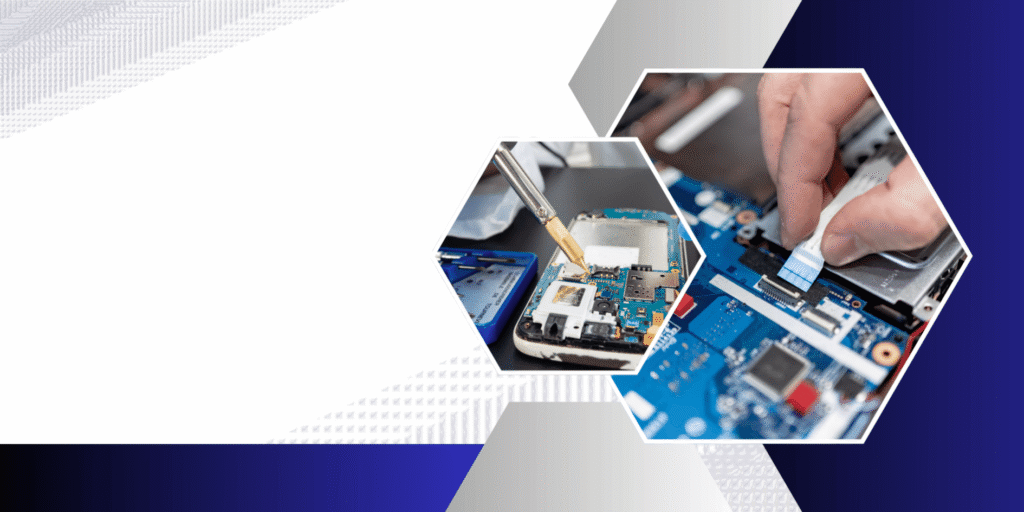
Laptops that are too old, damaged, or obsolete to be reused move into the recycling stream. Here, they’re carefully dismantled into their component materials:
- Metals — aluminium and steel from the chassis, copper from wiring, and small amounts of gold, silver, and palladium from circuit boards
- Plastics — casing and internal components, sorted by polymer type for reprocessing
- Batteries — removed separately, since lithium-ion batteries require specialised handling to avoid fire risk and environmental contamination
- Glass and screens — processed separately due to the different materials (and sometimes hazardous coatings) involved
Circuit boards are typically sent to specialised facilities capable of extracting precious metals safely, since this process requires controlled environments to prevent the release of harmful substances.
Step 5: Responsible Disposal of Hazardous Elements
Laptops aren’t entirely harmless once broken down — some components contain materials like lead, mercury, or cadmium in small quantities. Responsible recyclers ensure these are separated and processed according to environmental regulations, rather than ending up in a landfill where they can leach into soil and groundwater.
This is really the difference between a “kabadiwala” simply stripping a device for scrap metal and a certified e-waste recycler managing the entire lifecycle responsibly.
Step 6: Certification and Closure
Once your laptop has completed its journey — whether refurbished for reuse or fully recycled — a compliant recycler provides closing documentation. This typically includes a recycling or disposal certificate, which matters for two reasons:
- For individuals, it’s peace of mind that your device (and your data) was handled the right way.
- For businesses, it’s often a requirement for internal audits, IT asset registers, and ESG/sustainability reporting.
Why This Process Matters
India generates one of the largest volumes of e-waste in the world, and laptops are among the most common devices discarded every year. When a laptop is processed responsibly, it means:
- Sensitive data doesn’t fall into the wrong hands
- Reusable materials go back into the manufacturing cycle instead of being extracted freshly from the earth
- Hazardous substances are kept out of landfills and water sources
- You get fair value for equipment that still has worth
Selling your old laptop for recycling isn’t just about clearing space on your desk — it’s a small decision with a real environmental and security impact, provided it’s handled by the right people.
Final Thoughts
The next time you box up an old laptop for pickup, you’ll know it’s not simply vanishing into a scrap heap. It’s going through data destruction, assessment, refurbishment or material recovery, and responsible disposal — a process designed to protect both your information and the environment.
If you’re a business looking to dispose of laptops, desktops, or other IT assets securely and responsibly, Best Tech Reformers Pvt. Ltd. offers end-to-end corporate e-waste procurement — from asset valuation and secure data destruction to refurbishment, recycling, and full compliance documentation.
Get a Free Asset Valuation or call +91 461 12399 to schedule a pickup.